Thursday, October 2, 2014

Ahmadiyah dispute intensifies

Violence at the National Monument in Jakarta almost caused a conflict between Nahdlatul Ulama and Muhammadiyah in Lamongan


Nathan Franklin

franklin1.jpg
   A typical street scene in Lamongan, East Java, where FPI finds support from many Muhammadiyah members
   Nathan Franklin
1 June 2008 marked the sixty-third anniversary of the Pancasila ideology. On this day members of the National Alliance for the Freedom of Faith and Religion held a rally at the National Monument (popularly known as ‘Monas’) in Jakarta demanding that the controversial Ahmadiyah sect should be dealt with in accordance with Indonesian law rather than subjected to organised violence. Members of the Islamic Defenders’ Front (FPI) descended upon the gathering, harassing and assaulting them. It did not surprise many that the FPI took this action: for years its members have attacked Ahmadiyah mosques, prayer houses, and other properties throughout Indonesia, while calling on the government to disband the organisation.
The incident at the National Monument appeared to swing public opinion against the FPI. What should have been a day of celebration was instead transformed into a violent incident that reverberated throughout the country. For several weeks, the national media were flooded with reports about the incident at Monas. There was a cry from liberal groups and many ordinary Indonesians for the FPI itself to be disbanded. The government responded by arresting the FPI militant wing’s commander, Munarman, and central chief, Habib Risiek Shahib, for initiating the violence.
It is less widely known that the incident also had consequences outside the capital. In the East Java pesantren region of Lamongan, it very nearly caused a conflict between members of Nahdlatul Ulama (NU) and Muhammadiyah.

FPI in Lamongan

The FPI was formally established in Lamongan in July 2005, built upon a local organisation called ‘The Fighters Enjoining Honour and Forbidding Dishonour’. The Lamongan branch is relatively autonomous but nevertheless receives instructions from the FPI Central Leadership Board in Jakarta. A long-standing instruction commands FPI members to pressure the government to disband Ahmadiyah.
The FPI has a strong presence in the subdistricts of Brondong and Paciran, north of Lamongan. Local reports suggest their numbers range from 75 to 100 members. However, according to their leader in Lamongan, the FPI under his command can amass between five hundred and a thousand ‘soldiers of Allah’ when it goes on raids. The Lamongan group relies heavily on young males as foot-soldiers. The older members provide leadership in Qur’anic studies, and in directing physical operations. This is based on the FPI philosophy of ‘amar ma’ruf nahi mungkar’, derived from the Qur’anic verse in Surah Ali Imran (Ayat 104), ‘Let there arise out of you a band of people inviting all that is good, enjoining what is right, and forbidding what is wrong: They are the ones to attain felicity’.
Since this Brondong–Paciran area along the north coast of Lamongan is dominated by Muhammadiyah, the FPI ranks include many Muhammadiyah Muslims. In fact, the deputy leader of the FPI in Lamongan is also the headmaster of the Muhammadiyah pesantren of Karangasem in Paciran. Another Lamongan group whose membership overlaps with the FPI is the North Coast Islamic Youth Association, which was responsible for inviting Abu Bakar Ba’asyir to the area in October 2007 (see Inside Indonesia 92 ). Like the FPI, Ba’asyir encourages a rigid interpretation of ‘amar ma’ruf nahi mungkar’ during his sermons, selectively intertwining it with promotion of holy war and martyrdom. These narrow and literalist interpretations of Islam provide legitimacy for hardline Muslims in the area who wish to resort to physical action to achieve their objectives.

An NU–Muhammadiyah conflict in the making?

Even before the 1 June incident, former Indonesian President Abdurrahman Wahid (Gus Dur) had been an outspoken defender of Ahmadiyah’s rights and a frank critic of the FPI. Gus Dur argued that Ahmadiyah was not a threat to anybody, and that its followers were responsible citizens who deserved the same rights and privileges as other Indonesians. FPI founder Habib Risiek Shihab argued that Gus Dur was wrong and that Allah would judge him so. The situation developed into a heated public debate about tolerance and what methods were acceptable for dealing with such issues.

Police in Lamongan asked local religious leaders to discourage angry NU youth from confronting the FPI

Although there are no known Ahmadiyah members in Lamongan, the local youth wing of NU, known as the Ansor Youth Movement (GP Ansor), who are concentrated in the south of Lamongan, were angered by the way the FPI – and in particular Habib Risiek – treated Gus Dur. In a TV statement broadcast on Indonesia’s Channel One shortly after 1 June, Habib Risiek stated that Gus Dur could not have understood what happened at Monas because he was blind. Furthermore, he claimed that Allah protected the FPI from the former president’s efforts to disband it, and instead disbanded Gus Dur’s government. A local newspaper reported that the GP Ansor were about to come to the north coast of Lamongan from their base in the south to force the FPI to disband. According to a police chief in the area, there was a real concern that the row could develop into an NU–Muhammadiyah conflict, as a large number of Muhammadiyah members were affiliated with the FPI.
Police in Lamongan approached the local religious leaders, including the leaders of the Sunan Drajat School and the Lamongan branch of the Indonesian Council of Islamic Scholars, in the hope that these religious figures could persuade the GP Ansor not to come to the north coast to confront the FPI. This strategy proved successful. The GP Ansor members never arrived. Speaking afterwards, the leader of the Lamongan branch of NU downplayed the situation, saying the GP Ansor had planned to go to the Paciran-Brondong area only to get a clear picture of the FPI’s position in Lamongan. However, many local residents believe that the intervention and consultation initiated by the Lamongan police succeeded in averting a dangerous conflict which could have had serious long-term consequences.

Is the problem over?
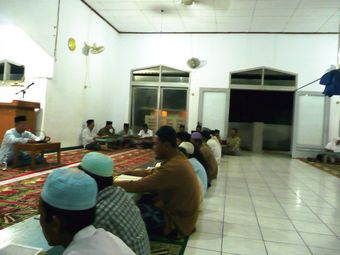
franklin2.jpg
    FPI members gather to study the Quran
    Nathan Franklin
According to polling conducted on the official NU website, 57 per cent of respondents maintained that the FPI was necessary to eliminate immorality and oppose liberal groups, while a quarter of respondents believed that the FPI should be disbanded because it ruined the image of Islam.
Both positions are found among the NU community in Lamongan. Some locals think that the FPI were just thugs and the organisation should be disbanded. Others see the FPI as useful for eliminating drinking, gambling and prostitution in the area. Although there were mixed opinions about disbanding FPI, there is considerable consensus among NU followers in Lamongan about Ahmadiyah. Most believe it should be disbanded because of its recognition of a prophet postdating Muhammad. Regardless of affiliation, all Lamongan residents believed that an NU–Muhammadiyah conflict would be detrimental to Islam.
The existence of Ahmadiyah and the FPI will continue into the foreseeable future, as will disagreements between Gus Dur and Habib Risiek. And as this example shows, events on the national stage can resonate in regional contexts and ignite religious conflict. There is reason to hope that the incident in this rural district in East Java has been resolved. But the history of rivalry in Lamongan means religious matters are highly charged and the potential for conflict remains.     ii
Nathan Franklin (nathan.franklin@cdu.edu.au) is a doctoral student at the Charles Darwin University, working on pesantren and Political Islam in East Java.

Inside Indonesia 95: Jan-Mar 2009
 http://www.insideindonesia.org/weekly-articles/ahmadiyah-dispute-intensifies

Wednesday, October 1, 2014

Faith and violence: The Islamic sect Ahmadiyah has been under official pressure and violent attack


Munawar Ahmad

In July 2005, several thousand followers of the Ahmadiyah movement were holding a jalsah, or annual gathering, at their headquarters, the Mubaraq campus in Bogor, just outside Jakarta, when a mob invaded the campus grounds. This attack received considerable media publicity in both Indonesia and around the world. But it was just the latest and most dramatic episode in what increasingly looks like an organised and systematic campaign of violence against Ahmadiyah.
Ahmadiyah, an Islamic religious movement founded by a nineteenth century visionary, Hazrat Mirza Ghulam Ahmad, from present-day Pakistan, first appeared in Indonesia in 1925. It has approximately 500,000 followers in the country, part of a world-wide movement led from Britain. Its views on some key matters are very different from mainstream Muslims. For example, followers of Ahmadiyah believe that Ahmad was the promised messiah. As a result, its followers often come under great pressure in Indonesia and elsewhere.
The July 2005 attack began when a group of activists from the well-known Islamist group the Islamic Defenders Front (FPI), hung a banner outside the meeting ground proclaiming ‘Ahmadiyah is un-Islamic, its Prophet is Mirza Ghulam Ahmad, its holy book is the Tazkirah.’ An FPI leader, Abdurrahman Assegaf, as well as others, made speeches denouncing Ahmadiyah as a ‘deviant sect’ and demanding that the meeting be cancelled.
Failing to have their way peacefully, on the second day, about 100 FPI members attacked the meeting. They began by throwing rocks at whoever they could see in the campus grounds. None of the Ahmadiyah members responded in kind, but 15 of them received head wounds. Although there was a police post located at the campus gates, the authorities did not prevent the growing crowd pushing down the gate, destroying and looting whatever they could find, breaking windows and burning copies of the Qur’an.
Most of the attackers came from the area of Parung, about one kilometre away from the campus. Other local people could do little more than look on. One of them, Trisno, told an Ahmadiyah production crew (who later produced a VCD detailing the attack) that it was the anarchy of the mob that seemed un-Islamic to him, and that the Ahmadiyah followers had behaved well and not disrupted the locals.

History of discrimination

This attack was just one of many attempts to forcefully dissolve Ahmadiyah in Indonesia. Between 1993 and 2005, 35 separate violent attacks on Ahmadiyah members were recorded around Indonesia. And since the attack in Bogor, there have been more.
Ahmadiyah’s problems in Indonesia flow from more than just mob rule. Since 1980 the movement has faced structural discrimination. In that year, the Majelis Ulama Indonesia (the government-endorsed Council of Islamic Scholars) released a fatwa (legal ruling) that Ahmadiyah was ‘outside Islam’, that it was ‘deviant’ and could lead others into error. Then Minister for Religion, H Alamsyah Ratu Prawiranegara, signed off on the decree. Eventually, in 1984, the Ministry of Religion in Jakarta issued an instruction to its offices in the regions to carefully monitor the movement and do what they could to prohibit its activities.
At the July 2005 attack, one of the main speakers denouncing Ahmadiyah was Amin Jamaluddin, a leader of the Islamic Institute for Research and Study (LPPI). LPPI is itself part of MUI. Its job is to study the religious credentials of movements within Islam, and its views are typically endorsed by the Ministry of Religion.
A few days after the attack on the Bogor campus, MUI again reconfirmed its view, issuing another fatwa declaring that Ahmadiyah are kafir (infidels). Since then, the Minister of Religion, Maftuh Basyuni, has repeatedly spoken out against Ahmadiyah. For instance, in February 2006 he warned them that its adherents would have to choose between returning to core Islamic beliefs or proclaiming themselves a new religion.

What is Ahmadiyah?

In sociological terms, the followers of Ahmadiyah are not strikingly different from other Muslims. They perform the five pillars of Islam: they pray five times a day, fast in the month of Ramadhan, read the Qur’an, recite the confession of faith and partake in the haj pilgrimage if they are able. Theologically speaking, however, Ahmadiyah is unique because it believes that prophets can appear after the Prophet Muhammad (peace be upon him [pbu]). They believe that Hazrat Mirza Ghulam Ahmad, the movement’s founder, was himself such a person.
This view about prophets and prophecy is the central source of conflict between followers of Ahmadiyah and most other Muslims in Indonesia. The Ahmadiyah understanding is quite unique. As Mirza Ghulam Ahmad himself wrote in the Tazkirah (Our Teaching), to confirm whether a person has truly been appointed by God as a prophet, he must first proclaim himself to be acting on God’s mandate. The community of believers then must make their own evaluation of the claim on the basis of the previous scripture.
This belief conflicts with that of the mainstream Islamic community. Mainstream sunni Muslims believe that there is a total of 25 prophets, and that none would come after the Prophet Muhammad (pbu). This view is based on an interpretation of the Al-Ahzab verse (33): 40 of the Qur’an which includes the Arabic phrase khataman nabiyiin, which is usually translated into English to mean that Muhammad (pbu) is the ‘seal of the Prophets’. The mainstream interpretation is that Muhammad (pbu) is the ‘last’ of the prophets. However, the Arabic word khatam in fact has several meanings, including ‘most perfect’, ‘most glorious’ and ‘ring’ or ‘seal’. Ahmadiyah followers interpret the phrase to mean that the Prophet Muhammad (pbu) was the main or most important of the prophets, thus not excluding the possibility that others would come after him. For them, it is thus not inconsistent to be both a Muslim and to believe that the founder of their movement was a prophet.
For many Muslims in Indonesia, however, this interpretation of the phrase ‘khataman nabiyiin’ is a dangerous insult to their own beliefs. MUI scholars are particularly angered by the belief that Hazrat Mirza Ghulam Ahmad could be considered a prophet, as well as by the view that his book, the Tazkirah, is a revelation from God and that Ahmadiyah followers make the haj pilgrimage not to Mecca but to Qadian.
In my own view, it is possible to reconcile Ahmadiyah’s beliefs with mainstream Islamic practice. Six centuries ago the famous theologian Ibn Arabi wrote that there would be prophets after Muhammad (pbu). In his view, the spiritual light provided by the Prophet Muhammad (pbu) would continue to glow after his departure. Indeed, he believed that the phrase ‘khataman nabiyiin’ guaranteed that there would be prophets after Muhammad (pbu); if there were not, this would mean that the spiritual strength of the message of the Prophet Muhammad (pbu) was weak, which could not be. In this respect, it might be possible to think of prophets after Muhammad (pbu) as carrying forward the mission of their great predecessor, in the way that, in Islam, Isa (Jesus) is seen as carrying forward the prophecy of Musa (Moses). Such prophets do not bring their own law, but instead revive and implement the law their predecessor has brough.

Ahmadiyah today

The theological controversy about the status of Hazrat Mirza Ghulam Ahmad is the root of violence against Ahmadiyah. The movement has been attacked not just in Indonesia, but also elsewhere, including in Bangladesh and Pakistan. As a result of the pressure they face from others, Ahmadiyah has become both more cohesive internally, and more exclusivist in how it deals with others.
Even so, Ahmadiyah is a fast-growing religious movement in many countries, including Australia. In Australia, the movement is based in Blacktown, Sydney, and has a beautiful large mosque and a congregation of about 2000 people, mostly Pakistani migrants. From the movement’s headquarters in Britain, Muslim Television Ahmadiyya (MTA) is broadcast globally. The channel provides information about Ahmadiyah’s vision of a rational Islam which can be applied easily in daily life, and which lays heavy emphasis on moral teachings and peace.
In Indonesia, it is almost as if the all the pressure has helped to promote Ahmadiyah. Many people have been attracted by Ahmadiyah’s peaceful resistance, and by the message of love that is at the heart of its vision. Data from 2004 suggests that over the preceding 12 years, there had been about 150,000 new converts in 298 branches around the country. This remarkable growth itself refutes the view that Ahmadiyah has no place in Indonesian society, as the movement’s detractors suggest. Indeed, it might just be that the cause of the violent reaction against Ahmadiyah is not just theological, but also derived from resentment at the movement’s success.
Munawar Ahmad (munawar_ahmad@lycos.com) is a lecturer at the Sunan Kalijaga State Islamic University in Yogyakarta. He is currently writing a PhD thesis on the political thinking of Abdurrahman Wahid. This article was translated by Edward Aspinall.

http://www.insideindonesia.org/feature-editions/faith-and-violence

Tuesday, September 30, 2014

Zafrullah Ahmad Pontoh, Ahmadiyah Indonesia Spokesman

The Jakarta Globe, on 10:01 pm Aug 05, 2010Zack Petersen

While most of the violence that has affected Ahmadiyah — a controversial sect that believes its founder was a prophet of Islam, a claim that contradicts the beliefs of mainstream Muslims — remains outside the capital, that doesn’t mean the nearly 10,000 members of Ahmadiyah here in Jakarta don’t feel intimidated.
Today, Zafrullah Ahmad Pontoh, the spokesman for Ahmadiyah Indonesia, talks to us from his mosque in Cideng, Central Jakarta, about the controversial attempts to close an Ahmadiyah mosque in West Java and his views on religious freedom.

What is the difference between Ahmadiyah and mainstream Islam here in Indonesia?
According to us, we are Sunnis because we understand that we follow the traditions of the holy prophet.
What differs between us and other Muslims is the interpretation of some of the verses of the holy Koran.
So in the Koran, as we understand it, there is the possibility of the coming of a prophet after the holy prophet of Islam.
What do you say to people who think members of Ahmadiyah are nonbelievers?
They are free to say that. But we believe that God accepts us as Muslims. Anyone can say anything they like.
We won’t say that they are nonbelievers because the holy prophet said that if you call a believer a nonbeliever, then you yourself are the nonbeliever.
Do you introduce yourself to people as a member of Ahmadiyah?
Yes. I just came from Sulawesi and most of my friends are not Ahmadiyah [members], but they saw the attacks in Kuningan and they said: “What kind of people would do this?”
You see, they don’t like this violence either.
Why were the people in Kuningan attacked?
What I understand is that the bupati [district chief] of Kuningan wished to close the mosque.
I understand that some people from outside Kuningan wanted the mosque closed. We had about 4,000 Ahmadiyah members there to protect the mosque in Manis Lor village.
And how do you feel about the church controversy in Bekasi?
Yesterday, I was at the House of Representatives. We are trying to gain religious freedom through dialogue not only for Ahmadiyah, but for all Indonesians.
Because Islam teaches us to live in harmony with others, and never to resort to violence.
The holy prophet never attacked nonbelievers first, he only defended and protected himself and Muslims. Islam is never spread by the sword.
How many Ahmadiyah members are there in Jakarta?
There are seven Ahmadiyah mosques here in Jakarta and around 10,000 Ahmadiyah members. Throughout Indonesia there are 500,000 Ahmadiyah members.
Do you ever fear for your safety?
As a human being, yes, but I still believe in the protection of God. I have no problem walking around the neighborhood here. I was out walking around before you came here.
Has there ever been an attack on this mosque?
The mosque has been here more than 70 years, and in 2006 some Muslims came and asked us to take down the name of the mosque, but I didn’t.
We have been trying to learn patience and love, but as human beings we have limitations, so to be patient is very hard.
I said: “Nobody can stop us from worshiping, God wants us to worship.” Nobody can tell us to stop doing what God wants us to do.
When there are clashes between Ahmadiyah and other Muslim groups, do you feel like the government gives you equal protection?
First, I should clarify that they are not clashes, but attacks. A clash means that there are two sides [fighting], but an attack is where we have to defend ourselves.
The Constitution gives freedom to every person to be a follower of any religion.
But it has to be one of the six official religions?
Yes, but we are Muslims.
Do you think that Ahmadiyah will ever be fully accepted and recognized in Indonesia?
Inshallah [God willing]. We always intermingle with people through love and I feel like love will overcome. Last year, nearly 1,000 people joined Ahmadiyah. You would be surprised how many people click on our Web site, www.alislam.org.
Didn’t the state come up with a law that said Ahmadiyah members are not allowed to worship in public?
Not a law made by the state, but there is a decree. I heard from some people that the current religious affairs minister said Ahmadiyah is straying from Islam.
He should not say that; he should understand how to protect our faith. But I believe he misunderstands the 2008 decree.
That decree only prohibits us from explaining publicly that there is a prophet after the Prophet Muhammad.
Isn’t that a violation of your religious freedoms?
Yes, but our leader said for the time being we should be quiet.
What would you say to the people who passed the decree?
I would tell them they are doing something different from the laws of the country. The decree says that we believe in the prophet, but it also hinders us.

http://jakartaglobe.beritasatu.com/archive/my-jakarta-zafrullah-ahmad-pontoh-ahmadiyah-indonesia-spokesman/

Saturday, September 20, 2014

MERAJUT RESISTENSI DI TENGAH REPRESI (Kajian Tentang Jemaat Ahmadiyah Indonesia di lombok , Indonesia)

MERAJUT RESISTENSI DI TENGAH REPRESI (Kajian Tentang Jemaat Ahmadiyah Indonesia di lombok , Indonesia)

Penulis

Ngatini

Pembimbing: Zainal Abidin Bagir, Ph.D,


ABSTRACT: "There is no action possible without little acting", said George Elliot as quoted by Scott in his work Domination and the Arts of Resistance (Scott, 1990: 1). I think Elliot's statement fits best to summarize what has been going with Indonesian Ahmadiyya in Lombok, West Nusa Tenggara. Indonesian Ahmadiyya in Lombok is part of Indonesian Ahmadiyya congregation (JAI), an Islamic sect which has been condemned by the Indonesian Ulama Council (MUI) in 1980 and repeated in 2005 as defiance of Islam due to its belief in Mirza Ghulam Ahmad as the promised Messiah. FollOwing the religious decree of MUI issued in 1980 and reissued in 2005 which banned Ahmadiyya's religious activities, there have been numbers of efforts to inhibit Ahmadiyya's teaching from growing and to bring the members of Ahmadiyya back to the "right tracl('. These efforts find their way in so-caned coercive persuasion (Lofland & Skonovd, 1981). In Lombok, the coercive persuasion has many forms ranging from legal laws of local governments banning Ahmadiyya activities, bribery, intimidations, exclusions from social activities, stoning, expulsion, house burnings, robbery, to killing. The coercive persuasion that has been taking place since 1972 leads Indonesian Ahmadiyya congregation in Lombok to experience objective-subjective deprivations (Beith- Hallahmi & Argyle, 1997). Those objective-subjective deprivations are like losing dwelling places, losing jobs, losing family members, losing possessions, undergoing psychological disorder, fleeing from their hometown, doing refugee from one place to another place and finally living in refugee camp for more than 6 years. Still, despite being in the face of miasma, JAI In Lombok, persists being Ahmadis, doing their daily activities as usual and resistance at the same time. Employing sociological approach, this research intends to investigate why certain numbers of lAI in lombok remained to be Ahmadis under such miasma. Furthermore, this research afso aims to explore how some people who remained to be Ahmadis adjust themselves to such coercive and persuasive condition and deal with their objective-subjective deprivations. The data for this research were collected through a series of individual in-depth and group interviews with Ahmadis and non-Ahmadis, participative observation over the Ufe of JAI in Lombok, and studying the literatures on Ahmadiyya issue from January to February 2012. The research shows that there are three kinds of reasons of why certain numbers of people remained to be Ahmadis despite such miasma they face; theological reason, sociological reason, and ethical reason. Meanwhile, to make the impact of coercive persuasion and the objective-subjective deprivation less severe, they do, following Scott, everyday forms of resistance or the infra-politic of subordinate group. Relying on Scott's theory of reSistance, , categorize the resistance of jAr in Lombok into two groups; public resistance and domestic resistance.
INTISARI: Tidak ada satupun sikap yang muncul tanpa ada sedikit unsur akting, kata George Elliot seperti yang dikutip Scott dalam bukunya Domination and the Arts of Resistance (Scott, 1990: 1). Pemyataan elliot tersebut tidaklah berlebihanjika diterapkan untuk memahami kasus yang terjadi pada Jemaat Ahmadiyah Lombok, Nusa Tenggara Barat (NTB). Jemaat Ahmadiyah Lombok merupakan bagian dari Jemaat Ahmadiyah Indonesia (JAI), salah satu aliran dalam Islam yang difatwakan sesat dan menyesatkan oleh Majelis Ulama Indonesia tahun 1980 dan diulangi kembali tahun 2005. Menyusul fatwa sesat tersebut,berbagai usaha untuk mencegah pertumbuhan eksistensi ajaran Ahmadiyah dan mengembalikan anggotanya ke ''jalan yang benar", terus dilakukan dengan jalur persuasi koersif (Lofland & Skonovd,1981). Di daerah Lombok upaya persuasi koersif yang diwujudkan dalam berbagai bentuk dari penerbitan berbagai surat larangan penyebaran ajaran/paham Ahmadiyah oleh Bupati dan Kepala Kejaksaaan negeri; bujukan halus dengan berbagai janji dan ancaman; ejekan; pengucilan dari dunia kerja dan pergaulan sosial; pelemparan batu; pemukulan; pengusiran; pembakaran rumah; penjarahan harta; hingga penghilangan nyawa. Persuasi koersif yang terjadi sejak 1972 hingga 2011 ini mengakibatkan jemaat Ahmadiyah Lombok mengalami objective-subjective deprivation (Beith-Hallahmi & Argyle, 1997) seperti kehilangan tempat tinggal, kehilangan sumber mata pencaharian tetap, kehilangan anggota keluarga, kehilangan harta benda, terusir dari kampung halaman, mengungsi dari satu tempat ke tempat lain selama 6 tahun, menderita gangguan kejiwaan, dan lain sebagainya. Namun, semua usaha persuasi koersif tersebut tidak terlalu membuahkan hasil, terbukti meskipun sudah dilarang dan diberi ancaman dalam berbagai bentuk masih ada jemaat yang memutuskan tetap menjadi Ahmadiyah dan beraktivitas seperti biasa bahkan mencoba melakukan resistensi. Melalui pendekatan sosiologis, penelitian ini bertujuan untuk mengeskplorasi alasan mengapa sejumlah jemaat Ahmadiyah di Lombok memilih untuk tetap menjadi Ahmadiyah di tengah tekanan keras kelompok mayoritas Muslim. Selain itu, penelitian ini juga ditujukan untuk mengetahui bagaimana pola adaptasi jemaat Ahmadiyah Lombok yang bertahan tersebut terhadap situasi yang mereka hadapi. Data dalam penelitian ini didapatkan melalui serangkaian wawancara mendalam dengan jemaat Ahmadiyah dan pihak non-Ahmadiyah; observasi partisipatif terhadap kehidupan jemaat Ahmadiyah; studi literatur terhadap sumber tentang Ahmadiyah dari berbagai sumber; dan mengumpulkan data dari bulan Januari sampai dengan F ebruari tahun 2012. Hasil penelitian ini menunjukan bahwa ada tiga alasan mengapa sejumlah jemaat memutuskan untuk tetap menjadi Ahmadiyah di tengah tekanan keras mayoritas Muslim dan pemerintah, yaitu alasan teologis, alasan sosiologis dan alasan etis. Sementara itu, untuk dapat meminimalisir dampak tekanan dari kelompok mayoritas Muslim yang tidak menghendaki keberadaan mereka, jemaat Ahmadiyah Lombok melakukan resistensi yang penulis kategorikan menjadi dua; resistensi publik dan resistensi domestik. Kedua jenis resistensi ini merupakan jenis resistensi yang disebut oleh James C. Scott sebagai everyday forms ofresistance atau the infrapolitics ofsubordinate group.
Kata kunci persuasive coercion, objective-subjective deprivation, everyday forms ofresistance
Program Studi UGM
No Inventaris 3182-H-2012
Deskripsi 174 p., bibl., ills., 29 cm.
Bahasa Indonesia
Jenis Tesis
Penerbit [Yogyakarta] : Universitas Gadjah Mada, 2013
Lokasi Perpustakaan Pusat UGM

Ahmadiyah Lahore dalam Revivalisme Islam di Indonesia*

Ulumul Qur'an, Vol. X/ No. 1/ Th. ke-25/ 2014, hal. 41-47
Oleh Ahmad Najib Burhani

Gerakan Ahmadiyah Indonesia (GAI) --yang populer disebut Ahmadiyah Lahore-- sesungguhnya telah hadir sejak zaman pergerakan, sezaman dengan organisasi-organisasi keagamaan "klasik" seperti Muhammadiyah, NU, SI. Corak modernitas dan rasionalitas Ahmadiyah Lahore menjadikan organisasi tersebut bisa diterima semua pihak, tidak terkecuali tiga organisasi keagamaan di atas. Bahkan putra tokoh sekaliber KH Ahmad Dahlan, yaitu Erfan Dahlan, sempat dikirim untuk belajar ke Lahore. Kehadiran Ahmadiyah Lahore juga boleh dikatakan menjadi "penyelamat" keislaman bagi tokoh-tokoh pergerakan, seperti Ruslan Abdul Ghani, Cokroaminoto, Soekarno, dan Haji Agus Salim.

*Naskah inimerupakan transkrip dari ceramah Ahmad Najib Burhani pada seminar yang diselenggarakan dalam rangkaian Jalsah Salanah GAI pada Desember 2013. Terima kasih kepada Ali Sodiqin yang telah merekam acara dan Tina Afiatin Yatimin yang telah membantu mentranskripnya ke dalam bentuk naskah.

Wednesday, September 17, 2014

PPIM Seminar on "Batas-batas Kebebasan Beragama di Indonesia: Kajian terhadap Sila Ketuhanan Yang Maha Esa dalam Pancasila"

Presenter in the 16th PPIM Seminar on "Batas-batas Kebebasan Beragama di Indonesia: Kajian terhadap Sila Ketuhanan Yang Maha Esa dalam Pancasila", at Gedung PPIM UIN Jakarta, September 17, 2014.


http://conference.studia.ppim.or.id/index.php/ppim-seminar/seri-ke-16

Thursday, August 7, 2014

Erfaan A. Dahlan ke Thailand sebagai Moeballigh Islam dari Gerakan Ahmadijah Lahore

Sumber: (Pandji Poestaka, No. 84, Tahoen VIII, 21 October 1930, hlm. 1340).

"Toean Erfaan A. Dahlan ke Siam. Dari Poerwokerto orang menoelis: Pada tanggal 15 Oct. jl. T. Erfaan A. Dahlan, pembangoen pergerakan Moehamadijjah Indonesia telah berangkat dari Djokja dalam perdjalanannja ke Siam. Tg. 18 Oct. Beliau berangkat dari Tg. Priok. Berangkatnja t. Erfaan A. Dahlan ke Siam itoe ialah sebagai Moeballigh Islam dari Gerakan Ahmadijah Lahore, jang bermaksoed akan mengembangkan ke-Islaman dan persaudaraan internasional di Siam. Beliau ialah poetera Indonesia jang pertama kali jang berangkat mengembangkaan persaudaraan Islam kenegeri Asing. Beliau telah tammat peladjarannja disekolah Ishaat Islam College Lahore, jaïtoe salah satoenja sekolah Ahmadijjah disana dengan peladjaran Theology (Islam, Kristen, Hindoe dan Boedha) dan mengetahoei bahasa Inggeris, ‘Arab, Parsi, Urdu dan Sanskrit. Toean Erfaan telah 6 boelan ada di Hindia oentoek bertemoe dengan sanak-saudaranja.”


Courtasy of Dr. Suryadi Sunuri of Leiden University.

Response to this news from Erfaan Dahlan's son (Dr. Winai Dahlan of Chulalongkorn University):

"My father was sent by Muhammadiyyah to Lahore in 1924. He finished his study around the year of 1930 and went directly to Pattani of Siam (Thailand). When my aunt (Aisah) and her daughter (Mizaroh) visited Bangkok around the year 1961 (or 1962), she told us that it was the first time she met her younger brother (Erfaan). Since 1924, he'd never been back to Indonesia. This was confirmed by my father. I don't understand that news but please learn that Ahmaddiyyah had tried to take advantage of my father and with his intelligence he knew it. Studying with Ahmaddiyyah school in Lahore was not false of Erfaan. He was the great man and behaved as a gift for us all in Thailand and he was not Ahmadis."

Personal correspondence on 17 January 2015